

First-Time Home Buyer Inspection Checklist (2026): What We Check, What We Don’t, and What You Should Add


A standard inspection covers roof, structure, electrical, plumbing, HVAC, attic, crawlspace/basement, and interiors—but first-time buyers are often surprised by what’s not included. Scope can vary by property access and local standards. If you’re trying to coordinate multiple inspections, ask about our bundled packages—designed to make scheduling easier and often save money compared to booking services separately.
Use this home inspection checklist for buyers (2026) to understand what a standard inspection typically covers on a home inspection in Gainesville, what specialty inspections are separate, and which add-ons are worth considering based on your home type in Alachua.
Key Takeaways
A standard inspection is visual and non-invasive, focused on accessible areas.
Specialty services (Termite(WDO), sewer scope, mold, pool) are typically separate.
Bundled inspection packages can combine common needs into one booking—simpler scheduling and potential savings vs. à la carte services.
Home age, foundation type, and utilities (well/septic vs public) should drive add-ons.
Attending the summary helps you learn the home faster and ask better questions.
Who this is for: First-time buyers (and the parents/family helping them) buying near Gainesville.
Need this checked fast?Call/Text 386-361-8040 to book an inspection or ask a quick question.
Here’s a simple way to make booking easier: choose a package. Our packages group the most common inspections together so you have fewer moving parts to coordinate during your inspection window.
Prime Package: Home Inspection + 4-Point + Wind Mitigation (if applicable) + basic thermal imaging (plus included warranty/guarantees—ask for details).Prime Plus Package: Prime Package plus your choice of WDO/Termite Inspection* or full thermal imaging.Premier Package: Prime Package plus WDO/Termite Inspection* and full thermal imaging.
*WDO/termite inspections are performed by a Florida-licensed pest control operator.
Standard inspection scope
Here’s what a standard inspection typically includes. Exact scope varies by inspector, property type, and access.
Roofing & exterior
Roof covering (visible areas), flashing, penetrations, gutters/downspouts
Siding/trim, windows/doors, visible drainage/grading observations
Structure
Visible foundation areas and accessible framing
Signs of movement (cracks, settlement indicators) based on what’s accessible
Electrical
Main panel/subpanels (as accessible), visible wiring, a representative number of outlets/switches
Safety items such as GFCI protection in common wet/location areas (as applicable)
Plumbing
Visible supply and drain lines, fixtures, water heater
Leak checks at accessible connections; water pressure observations
HVAC
Heating/cooling operation (weather and power permitting)
Visible ducting, condensate management, and accessible components
Interiors
Walls/ceilings/floors, doors, basic built-ins
Attic/crawlspace/basement (when accessible) for insulation, ventilation, moisture indicators
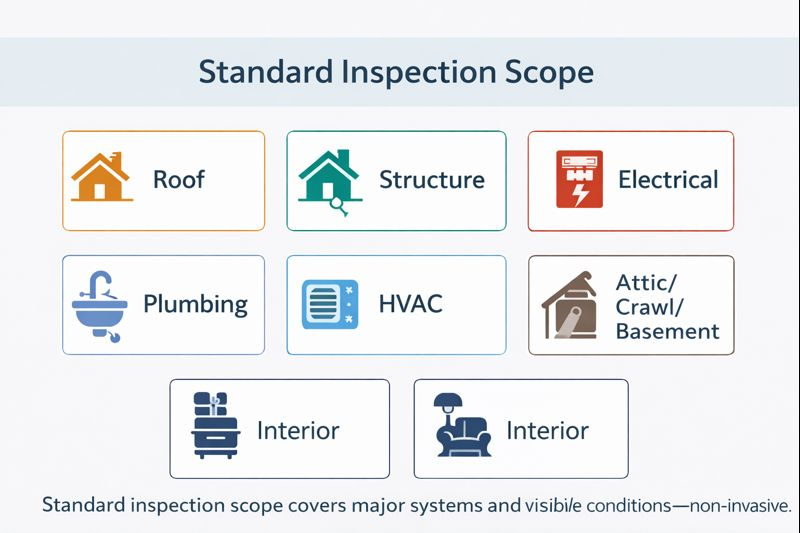
Inspector’s Note: Inspections are visual and non-invasive. We don’t open walls or move heavy items. If access is blocked (attic hatch, crawlspace entry, electrical panel, water heater closet), we can only report what’s visible and note limitations.
What inspections do not cover (pest, sewer line, mold, pool)
Many first-time buyers assume these are included. They’re usually separate services or handled by specialty providers: Some of these can be bundled or coordinated at booking—so you’re not chasing multiple appointments during a tight timeline.
WDO/pest inspection (wood-destroying organisms/termite-related issues)
Sewer scope inspection (camera inspection of the main sewer line)
Pool/spa inspection
Mold testing
Septic/well inspections (where applicable)
Full Thermal imaging (optional; can help identify temperature anomalies that may relate to moisture or insulation—confirmation usually requires follow-up)

Add-ons by home type (older homes, slab homes, well/septic)
Pick add-ons based on risk, home type, and what you can realistically schedule during your inspection window.
Older homes (often pre-1980)
Sewer scope (older drain materials and tree roots can be a factor)
WDO/pest inspection (wood framing + conditions vary)
Thermal imaging (helpful when moisture concerns are suspected)
Slab homes
Sewer scope (repairs can be more disruptive depending on line location)
Plumbing-focused evaluation if there are symptoms (slow drains, prior leaks)
Well/septic properties
Well flow/quality testing (as available)
Septic evaluation by appropriate specialists (tank/drain field considerations)
Homes with lots of trees
Sewer scope (roots can impact older lines)

Send us the listing address and we’ll recommend the right add-ons. Call/text 386-361-8040.
How long it takes + how to attend
Typical inspection durations (varies by size/age/access)
Condo/smaller home: ~2–3 hours
Typical single-family: ~3–4 hours
Larger/older/complex: ~4+ hours
How to attend without getting overwhelmed
Arrive for the last 45–60 minutes (best time for the walkthrough summary)
Bring 5 questions (roof age, HVAC age, moisture history, electrical panel type, drainage)
Ask: “What should I address now?” and “What should I budget for in year one?”

The #1 mistake first-time buyers make
Waiting too long to decide on add-ons.If you’re inside an inspection window, scheduling can get tight in Gainesville and Alachua If you think you want a sewer scope, WDO inspection, or other specialty service, decide early so you can coordinate efficiently.
Quick buyer checklist
Confirm your inspection contingency dates with your agent
Book the standard inspection early
Add specialty services based on home type and observed risk
Ensure access: attic hatch clear, crawlspace entry open, utilities on, gates unlocked
Mini FAQ
1) What does a home inspector look for most? Safety concerns, active moisture indicators, visible structural red flags, and whether major systems appear to operate normally based on accessible, visual observations.
2) Is a radon test always necessary? It depends on location and personal risk tolerance. If you’re considering it, schedule it early so it doesn’t squeeze your inspection timeline.
3) Do you offer inspection packages to save money and simplify booking? Yes—our Prime, Prime Plus, and Premier packages bundle common inspections so you can schedule faster with fewer steps. Call/Text 386-361-8040 and we’ll recommend the best-fit package based on the home type and your timeline.
Want us to inspect it before it becomes a problem?
Clear findings, photo documentation, and next-step guidance.
Understand what’s included vs what’s optional
Choose add-ons that match the home (not hype)
Know what to address now vs budget later
Call/Text 386-361-8040 to book.
Realtors/agents/investors: feel free to forward this to your client.
Requirements vary by insurer and property; consult licensed contractors for repairs.
